

I often find myself discussing and introducing ropes and how it would affect the bottom, whenever I start an introductory class. Given that I used to try to sell ropes, and also have a weird addiction to try a lot of different brand and make of ropes.
Of course, you have the usual ‘culprits’ – Jute ranks high, followed by hemp, then cotton or bamboo, then the occasional coconut or sisal ropes for the ‘seme feel’. (Personally I hate sisal or coconut ropes, does nothing other than making myself pain while tying).
Let me try this structure here:
- Single vs double ply
- Tight vs medium vs loose lay (Basically just how tight it is twisted)
- Diameter
Single Vs Double Ply
TLDR: Double Ply is stronger and last longer but lacks the flexibility and lightness of single ply rope.
So what is it about? Basically it is about how the rope is constructed at the base level – from the fibers to the twist. Single ply (jute) rope are made from a single strand of twisted (jute) fiber. While double ply rope are made from twisting two single ply strands together. So you are doubling the strength per twist. But because of the doubling, the ropes will be more rigid.
How to see? Simple. Find a sacrificial end of a rope and untwist the end. When you untwist, you’ll see it’s just individual fibers making up a single strand, then it is single ply. When you see two distinct strands wrapped around each other, then it is double ply.
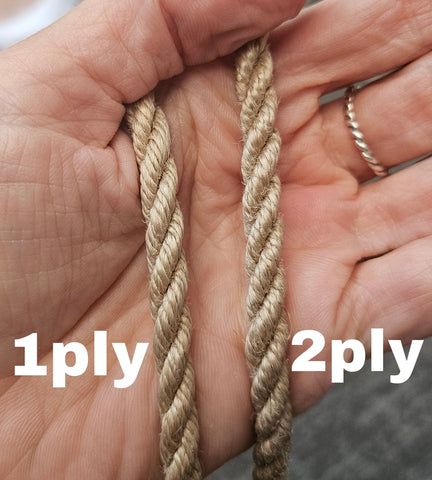
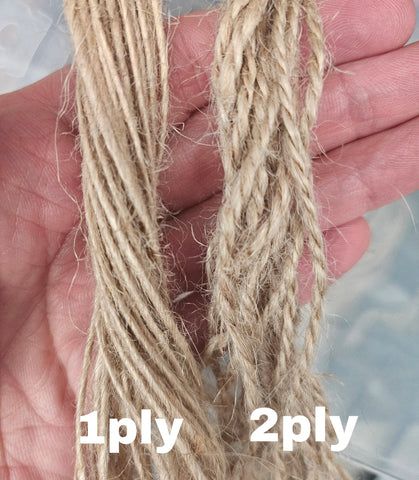
Double ply will be a lot more forgiving in terms of durability, rough handling and lesser maintenance required. But in terms of ‘feels’, it is largely your own opinion. (Strangely, at least to me) Double ply ropes are cheaper. My guess is that to maintain the base tensile integrity, longer fibers are required for single ply and hence the increase manufacturing costs.
In any case, the kind of jute that is most commonly used (and as well as the best) is from the genus Corchorus Olitorius – more commonly known as Tossa Jute. If you have heard of Asanawa Jute, it is just a Tossa Jute that underwent specially process steps specifically for Shibari. Plus the term Asanawa is sort of an all encompassing term for hemp, jute, cotton and what not as well…
Type of Lay (Direction and Tightness)
When we say the lay of the rope, we mean the direction and tightness of the rope. However, most shibari ropes are made with right lay (Z-twist), this was never too much of a concern. There is the left lay (S-twist), supposedly be better for left handers – I do not have much claim / experience on that, hence will not comment on it. But the direction is important especially when you decided to do a lark’s head when joining ropes though.
The tightness of the lay is actually more important here. It affects how you handle the rope as well as how the bottom feel the rope.
Hard Lay (Tightly Twisted)
- Stiffer rope
- Holds its shape well – not exactly a good thing because what you need is the lock and friction to be fixed. If it holds it shape (too) well, it just means it is harder to bend it. (You literally have to ‘beat’ it to be softer aka use it a lot more)
- Less flexible (because it holds shape well)
Medium Lay (Balanced)
- Offers a balance between strength, flexibility and handling
- Most shibari ropes are using medium lay for smooth knots and ease of tying (actually some will lean towards medium loose)
Soft Lay (Loosely Twisted)
- Rope is very flexible and soft
- Very easy to manipulate but less durable
Interestingly, a rope maker once told me that of all 3 lays, medium lay has the highest tensile strength, albeit marginally. The tight lay has almost the same tensile strength as loose lay. He mentioned that in tight lay, the opposing twist in the rope is already causing internal stress.. whilst the loose lay is, well, loose.
Personally, I would recommend pure beginners to spent some good money on tight lay ropes. Due to poorer rope handling techniques, most beginners will tend to dig into the ropes – i.e. fingers will dig into the strands of the rope. This will inherently weaken the rope and cause high stranding. Tight lay ropes, because it holds it shape too darn well, will prevent or lessen this occurance. And hence when they move to learning suspensions, the rope’s integrity will still be there.
But as you advance, you would want your ropes to be softer and more pliable. In this case, then get a medium to medium loose lay rope. They flatten better under pressure as well, making knots and frictions more comfortable for the bottom. The knots and frictions will also hold better in this case.
In any case, the more you use any kind of lay of rope, the more pliable it will be. Or you may want to abuse it during the breaking in process (which will also mean you shorten the lifespan of the rope as well) I got another post much earlier, on how to break in / season your ropes.
Diameter of Rope
Just do a search on shibari ropes from any manufacturer. It will range from 5.5mm to 6mm, sometimes with the uncommon diameter of 4.5m or 6.8mm. Why the difference?
To simply put it, the most obvious one of all, what is the size of your bottom? The bigger the bottom, the thicker the rope should be, especially if you are intending to do suspensions. Given the thicker diameter directly translates to higher tenstile strength as well. Can you use a 6mm rope on a small petite girl? Sure why not? But would that be aesthetically pleasing? (In my mind, it would be super safe to tying any one with a 20mm rope as well)
Lets do some simple math here. For a normal TK upper wrap, we will wrap the bottom twice. If we were to use 6mm ropes, that will be 6mm x 4 = 24mm on the upper wrap. Now versus a 5mm rope, it will be 20mm. The 4mm difference will then determine how much surface area lost/gain to hold the body weight to make it comfortable in suspension, or otherwise.
But let’s say, hey, I am not intending to do so much suspension. Maybe, just simple partials like just raising the hands or the legs, where 70-80% of the weight is still on the floor. Does the diameter of the rope comes in to concern here? Depends.
In some school of thought, one of the aspect is the choice of ropes. It leans towards ropes of 4 to 5mm, aka thinner ropes. Thinner ropes, bites into the skin better. The bottom feels the ropes a lot better. And it does translate to able to feel the nuances from the rigger, easier when compare to using a thicker rope. (Ignoring skill level here).
I have been toying with 4.5mm to 5.5mm ropes a lot with my bottoms and I can find that there is a correlation with them enjoying the ropes a lot more when I use a thinner rope. Though please do not be crazy to suspend with a 4 or 4.5mm rope. It does not hold and it is terribly painful / uncomfortable, and unless you want to increase your risk factor for nerve injury.
4mm to 5mm ropes are hard to come by, and if they do, it is expensive just due to the lower demand for them. But I do recommend them if you want your bottom to really feel the ropes and probably easier for connective?
 Nawa Kenshin