I signed up for Japanese lessons, like finally. It has been ‘bugging’ me for the longest time. Especially so when 1. I am not that good in languages for the start, 2. I had been contemplating this language since 2000. But yeah, finally dropped the bomb on myself and finally learning it, albeit ‘painfully’.
So, what does me learning Japanese have to do with Shibari? Or the bigger picture, what exactly is what I call “Shibari Language”? It is all about it. Quite literally.
When you are learning a new language, you typically get bombarded by a whole slew of stuffs. Like for example:
- The vocabulary
- The writing strokes, and this is especially so for most Asian languages where it is more ‘pictoral’
- The pronounication
- The sentence structure
- Meaningful sentence structure, so that people can actually understand you.
Now draw the parallel to learning and practicising Shibari. You typically need to know:
- The type of hitches and locks / frictions
- The common names of those ties / frictions
- The ‘standard’ foundation ties (e.g. Koden, ippon, wakizarashi, etc, depending which Ryu you subscribe to)
- Body manipulation / connectivity with each other
- Commmunicating with ropes so that each will understand / appreciate the session
You get the drift.

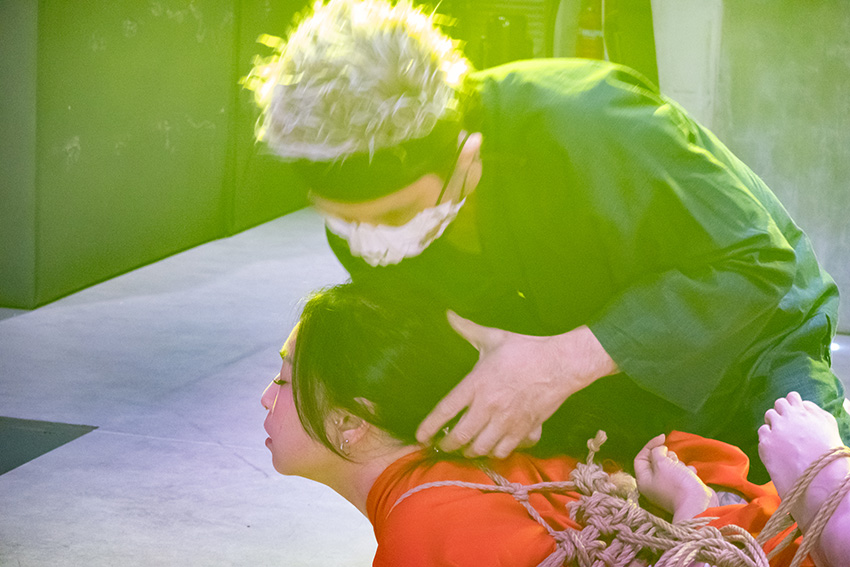
When I started off with tying back then, I was literally struggling with how to tie this, how to tie that. A lot of hows. I was literally building up my vocabulary for ties. Trying to master each lock, each hitch, and doing it without damaging my model, my ropes, my ‘ego’. Hence like any language, I needed some basic vocabulary to start conversing. In shibari, it was learning what was a munter hitch, a x-friction, a L-friction, etc.
But understanding these frictions (vocabulary) was not enough. You do not go about conversing with another person just using a single word nor sporadic singular words. (Well, unless you are a toddler learning how to talk.) You need to piece it together, and pronounce those words properly; else it get miscommunicated and woohoo, ‘fun’ might ensue. Likewise, in ties, when I want to do a diamond body harness (hishi karada), I should tie it with some amount of tension, doing the hitches properly, else it may become noodle body harness instead.
Tying a model properly, the technical aspect, can be parallel to forming good sentence with structure. Just like saying “I want a big mac from MacDonald’s”, the other party will know what you want to tie and confident that you know how to tie it and know how to identify it when you are done (presuming that they also know the names of the different ties). In this case, you are conversing with the partner, and both of you understand. As you get better and better in your ties, it is liken to that you have better use of your vocabulary and know how to craft better sentences, be it formal or informal.
So, let’s say you know all the ties in the world or have a very good knowledge of shibari. Or take for example, all the renown shibari masters in Japan. I can bet all of them have an extremely intimate understanding of how to tie. BUT, alas, why do they have so many styles, so many different ways to tie, so many different ways to excite the model. It is exactly the same issue when you and your buddy classmates write essay for your school work or your corporate proposal. It is the expert use of your own vocabulary into sentence structure. It is the choice of words you use when communicating with different people. Because you know how to choose and piece those words to SUIT the other person. Simple as that. By learning more words, learning more parallel stuffs, you draw from your own unique experience to deliver a custom ‘sentence’ during your tie.
Even if I am to have Weber’s dictionary and thesaurus with me, I may not be the best writer in the world. It comes to knowing which words to use together to deliver the message. This is best illustrated by the Japanese language. There is literally only that limited hiragana and katana letters. But the combination of each letter gives rise to the entire langauge / vocabulary. The number of hitches, frictions are kind of that limited in shibari. But how you use them together, how you wrap and the sequence of wrapping is almost infinite.
Just like a 7 – 14 year old, they have a good amount of vocab to use and can converse in good sentences. Most adults learn almost 90% of the English words that he needs to use for the rest of his life by the time he reach 14 year old. But you do not expect a 14 year old type a proper business proposal like a 40 year old. The language use, the intent and hidden intent… it comes with experience and lots of usage. Hence, shibari is literally like a langauge to be learnt and used extensively, to deliver more than just a technical experience but with a pleasurable connective one.
 Nawa Kenshin